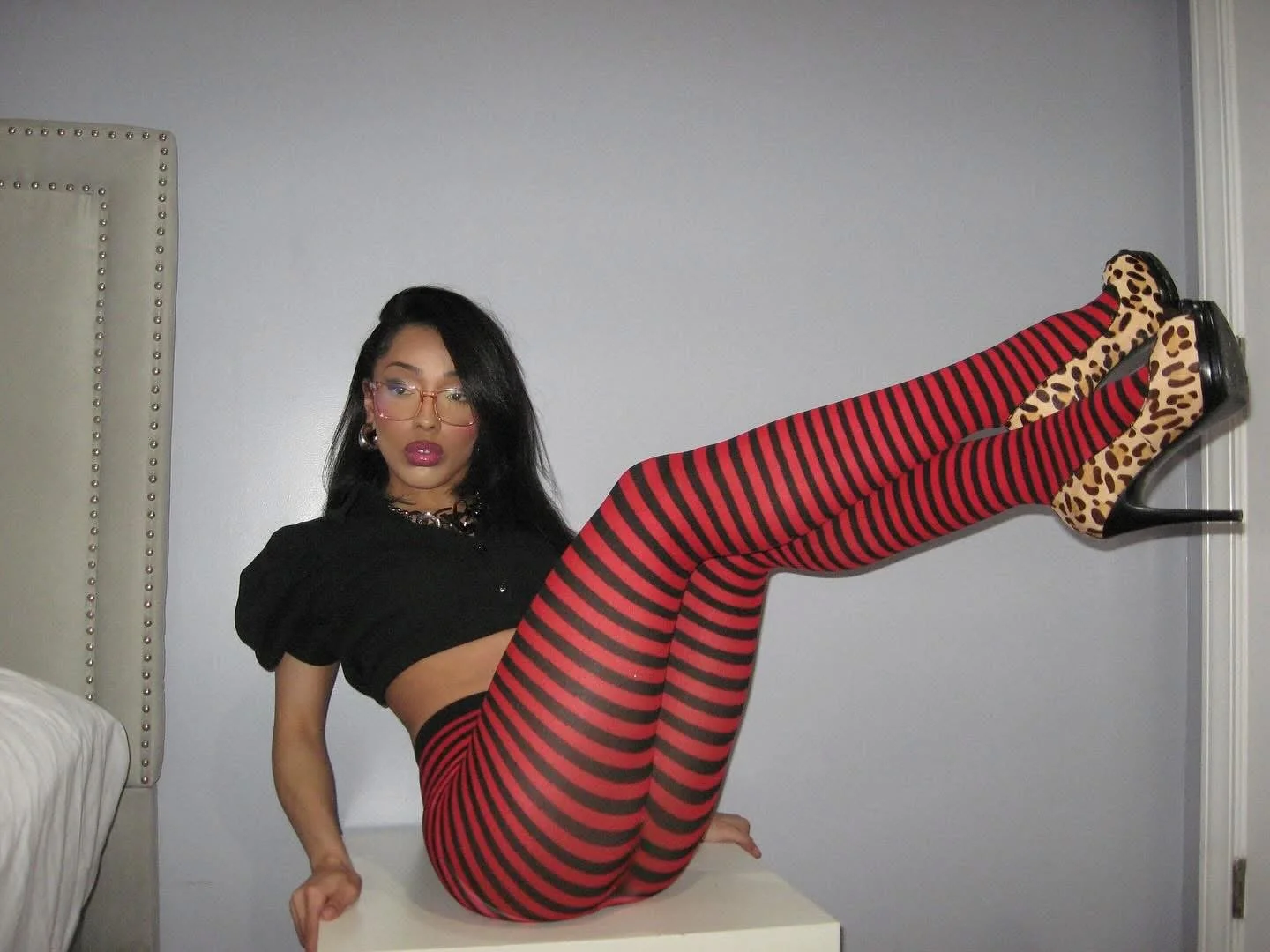
Veyonce Deleon (@Vzus) in red and black tights with cheetah-print heels, showcasing her bold personal style. Photo via Instagram, used with permission.
For Veyonce Deleon (Instagram: @Vzus), performance, in movement, voice, and personal style, becomes a way to tell stories. Born and raised in the Bronx, she discovered ballroom at seventeen. In that community, she found chosen family, joy, and self-expression that shaped her life and art. Since then, she has built a multifaceted career in Off-Broadway productions, fashion campaigns, and editorial work, all while staying connected to her community. In this conversation, Veyonce reflects on how performance nourishes her and her audience just as food sustains the body. She shares lessons from mentors and chosen family, revealing how art can sustain, inspire, and connect people.
Q: What emotions or memories came to mind from that initial encounter of stepping into ballroom?
A: Comfort and nervousness were mixed. I was shy and hesitant, but longed to vogue. Watching, I felt I'd found my community, even if I was unknown.
Q: Since we're speaking about community, ballroom has always been a space of chosen family and shared care. How does the community nourish you as a performer and as a person?
A: Community provides vital support in all my performances, whether in ballroom or musical theater. Support ranges from financial help to attend a ball, a place to stay when I compete, or receiving affirmation from those I admire. While self-belief is important, external affirmation from my community is powerful.
Q: Can you share examples of how sharing food or gathering around a meal creates and reaffirms connection in your chosen communities?
A: A great example of a shared meal that reaffirmed connection within my chosen community was with Shaun (my son). He made me breakfast in bed a day ago, so I bought him food that same night, and we bonded over it and watched the ball (Red Rally Kiki Ball) together. We're both very appreciative of someone feeding us, especially when we eat together. He made us a snack while we were waiting for the food to be done, and I just felt so loved that entire day, and I'm sure he did, too. Shaun asked me what love means to me in one word the next morning, and my answer was food. Food brings us all into the present moment, especially when it's made with love.
Q: Do you still find time to cook for yourself? And when you do, what's your personal relationship with the kitchen?
A: I've never really cooked for myself; it's always been for my family or a loved one. I'm usually alone in the apartment when I am prepping food for my parents, and I get to play my favorite music or put on a show while cooking. These acts make my connection to my cooking feel more spiritual and filled with love. When I'm relaxed, the food comes out better. You can taste the energy that went into someone's meal.
Q: You've moved between many creative worlds: fashion, theater, ballroom, music. How do these spaces feed one another, and where do you feel most at home?
A: My creative work is all interconnected. Fashion influences my stage presence and confidence, whether I'm on a red carpet, in a musical theater production, or in a photoshoot. Each art form, acting, voguing, and singing, lets me express my individuality. Bringing my personality and choices connects all my work.
Q: Who are the storytellers or mentors you look up to, and how have they shaped your work?
A: I have to give a shout-out to Whitney White. She's a musician and actor, and she was the director of the musical I was just in, Saturday Church. I researched her before I even started the show. I was lucky to work with her from our first workshop, before the show existed. Whitney was the first Black woman in my life to show me it's okay to be playful and try new things daily, without judgment. She changed how I approach my work. Her playful spirit makes me better, and I deeply admire her.
Q: How do the textures of your upbringing in the Bronx, the music, the food, the people, show up in your creative work today?
A: The first word that comes to mind is "unapologetic." People from New York, especially the Bronx, have an unapologetic nature. We're known for being loud, expressive, and "out there," and that deeply affects my personality. From loud music in the streets to constant conversation outside my window, New York's noise shaped me. I don't suppress that energy when I enter a room. It's just who I am.
Q: You've been a part of an interdisciplinary film, Being: A Digital Griot. In your own words, how do you define what it means to be a griot in your work?
A: For me, being a griot means having a willingness to do things that scare me, especially in sharing my story through different mediums. Despite my shyness, I've always been drawn to various art forms and pushed myself to pursue them. I've never considered myself the best singer, dancer, or actor, but I've always believed I was good enough to be in the room and contribute. Being a griot is about embracing fear, stepping out of your comfort zone, and using these opportunities to document and share experiences.
Q: In your acting, voguing, and vocal work, what connects these different languages of expression for you?
A: I prefer words, and ironically, I feel it's the medium I've used the least. I want to act and use my voice more, letting people hear me speak. While voguing taught me playfulness and experimentation, being authentic within all these art forms is a shared expression. People bring their unique choices and personalities to every character they embody, and I aim to carry that authenticity into everything I do.
Q: How do you care for yourself when the act of performing, of giving, takes so much energy? Can you share a moment where your art felt especially nourishing?
A: Leaning on the people around me has been crucial. While I typically recenter myself alone, lately, being around the cast, hanging out, learning about them, laughing, and playing games has truly recharged me for the demanding weeks ahead. Community, in whatever form, keeps you alive; it provides togetherness and relatability.
My favorite clip of myself is my LSS from the Gotham Ball. I was intentional with every detail, from my fashion and vogue to my hair and makeup, and it unfolded exactly as I had pictured it. Another moment that moved me was seeing The Effect at The Shed. A monologue by a woman expressing exhaustion with her emotions and memories profoundly affected me and inspired me to strive to deliver that same impact in my own work.
Q: We spoke about performance and community as nourishment. Are there foods that feel nourishing to your creativity or spirit, similarly?
A: Foods that feel most nourishing to my creativity are nutrient-dense foods that make me feel energized day to day. I love salmon, eggs of any style, and pressed juice. These feel like fuel for me. I've tried to remove foods that deplete my energy or affect my nervous system. Any meal that calms my body and supports my cognition is essential to my creativity.
Q: And, in your eyes, what does nourishment look like beyond food?
A: I think community is nourishment. Being around people, in whatever way that looks for you, is what keeps you alive. No matter what you do, you're interacting with others, and that connection matters. You don't have to convince anyone they need community; everyone does. We all need a sense of togetherness and relatability in what we do.
For me, performing is my way of connecting. My audience is my community. We're sharing an experience. I'm here to give, and I hope they leave with something. I want them to be moved the way I am when I watch a play, the way it shifts you, inspires you, and changes you. That feeling, that exchange, that is what community is. That is what feeds me.
